The album "WORKING" contains 10 songs. The lyrics below are from Bob Dylan and his song, which was recorded in 1968 for my album.
"To Ramona"
Ramona, come closer,
Shut softly your watery eyes.
The pangs of your sadness
Shall pass as your senses will rise.
The flowers of the city
Though breathlike, get deathlike at times.
And there's no use in tryin'
T' deal with the dyin',
Though I cannot explain that in lines.
Your cracked country lips,
I still wish to kiss,
As to be under the strength of your skin.
Your magnetic movements
Still capture the minutes I'm in.
But it grieves my heart, love,
To see you tryin' to be a part of
A world that just don't exist.
It's all just a dream, babe,
A vacuum, a scheme, babe,
That sucks you into feelin' like this.
I can see that your head
Has been twisted and fed
By worthless foam from the mouth.
I can tell you are torn
Between stayin' and returnin'
On back to the South.
You've been fooled into thinking
That the finishin' end is at hand.
Yet there's no one to beat you,
No one t' defeat you,
'Cept the thoughts of yourself feeling bad.
I've heard you say many times
That you're better 'n no one
And no one is better 'n you.
If you really believe that,
You know you got
Nothing to win and nothing to lose.
From fixtures and forces and friends,
Your sorrow does stem,
That hype you and type you,
Making you feel
That you must be exactly like them.
I'd forever talk to you,
But soon my words,
They would turn into a meaningless ring.
For deep in my heart
I know there is no help I can bring.
Everything passes,
Everything changes,
Just do what you think you should do.
And someday maybe,
Who knows, baby,
I'll come and be cryin' to you.
lyrics and music by Bob Dylan
This song was recorded for "WORKING" but never made it on the album.
Thursday, June 19, 2008


Tuesday, June 17, 2008
(part 78) CHOOSING THE SONGS FOR THE ALBUM "WORKING"

I had been drinking a lot of Southern Comfort when I began thinking about making the album "Working." I was also taking a lot of pills at the time. The reason I started drinking Southern Comfort was because Janice Joplin drank the stuff by choice. In 1967 or 68 I watched Blue Cheer and Janice do a gig at the Whiskey A Go Go. After the show I ended up at a cabin style motel in Hollywood, on Sunset Blvd. with two members of Blue Cheer to meet Janice.
We waited around awhile until Janice showed up with a quart of Southern Comfort in her hand. She began laughing and joking with the two guys from the Cheer, who she knew well from San Franciso, and quickly glanced over at me like I was a candy bar. One of the guys from Cheer introduced us, and she looked over the top of her Granny glasses at me and smiled. I recall vividly, watching her put the bottle to her mouth and chug a lug an amazing amount of alcohol on the spot.
I was so impressed by her ability to consume that much booze, that I quickly became a fervent user of Southern Comfort, and always told people about Janice when they asked how I could drink that shit. The reason we were all at the motel that night to meet with Janice was for the purpose of a cattle call for her, somethings guys have been doing forever.
In Janice's case it was in reverse. She wanted to look the goods over and pick the one she wanted. On that particular night I guess I didn't strike her fancy. I didn't know whether to feel lucky or insulted. Anyway, that's why I started drinking Southern Comfort, which is a lethally sweet alcohol in your choice of 86 or a 100 proof. I drank the latter.
As the possibility of making another album became more of a reality in 1968, I thought long and hard about the enormous amount of controversy some of my song writing had created with Verve. I thought that possibly using other people's songs might be a worthwhile change if I actually did another album.
I can't really remember how much I discussed the subject of doing other people's songs with Steve Clark and Bob Ross, but in fact it did become reality in the end. There was also something else that played into the final outcome, and that was that I used to sit at the piano and actually play and sing these songs like a live solo performance.
"Color Him In" had been created using a lot of overdubs. That means, if you are not familiar with the term, that the musicians played the music without me singing. When they were done, we would all listen to what they'd recorded on earphones, and then add my vocal, background vocals, and other things to the recorded music after the fact. It's a common way of recording, but a lot of the time it kills the performance of a live session.
In the case of "Working," one of the things I wanted to do was make it more of a "live" performance. The fact that I could, and did sit down and play these particular songs, was one of the reasons the selections were chosen in the long run. There were three songs written by me, "Palo Alto," "Broken Windows," and "Bout Being Young." I figured that no one could be upset by these songs for being "out there."
If anything, those three songs were as easy going as I could get. "Palo Alto" was my answer to Jimmy Webb's "Wichita Lineman," which I thought was a masterpiece. "Bout Being Young" was my attempt at a Dean Martin impression, after hanging around his house for all those months with his daughter Deana, who I had dated. "Broken Windows" was just a country song I wrote for the hell of it.
The rest of the songs were things I liked to play, with the exception of "Gentle On My Mind." The reason I cut the song the way I did, was because of Joe Cocker's version of The Beatle's "With A Little Help From My Friend's." If you are familiar with that rendition, you know that Joe Cocker made it into a hit, doing it his way. So that's how my version of "Gentle On My Mind" came about.
Don't get me wrong I actually played this song a lot before I cut it, but the Glen Campbell version was hard to top, so I reworked the song, on the basis I outlined, for a different approach and feeling. The rest of the songs on the album all have a story as well, and I will go into them in subsequent posts.
Friday, June 13, 2008
(part 77) IT WAS THAT SIMPLE FOR ME
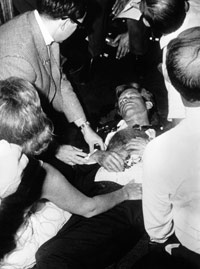
Bobby Kennedy asassination 1968

Martin Luther King assassination 1968
In 1968, three very important things happened in America. In April of that year Martin Luther King was assassinated in Memphis, Tenn.. In June of that year Bobby Kennedy was assassinated in Los Angeles, and in August of 1968 there were huge riots in Chicago at the Democratic National Convention, which assured that Richard M. Nixon would be elected the next President of The United States Of America.
The level of depression and anger that was being felt across this country, and the whole world for that matter, following these events, was palpable as 1968 moved towards it's final months. Because the shock of what had happened was so complete in that year, it was responsible for altering the lives of millions forever. It was hard to put your finger on exactly how much changed as a result of the year's volatility exactly, but I know that I had a feeling deep inside me that never left.
It was as if you finally knew that those in power were never going to let certain things happen. If you looked to change things too much, too fast, that power would rise up in one form or another and take you out. We had seen this happen, and then happen again, and again. It was as if it were being beaten into us through repetition.
Life changed! There was a sense of paranoia that was creeping into our lives in 68. The freewheeling open mindedness of the early 60's began to dissipate like a slow leak from a tire. It took some time, but the paranoia was definitely there to stay. Back in those days I began to reevaluate my own position in life.
One day Steve Clark approached me out of nowhere, saying he was having financial troubles, and couldn't continue paying me $100 a week to write songs for Since Music anymore. This was a devastating blow, but Steve also said he was trying to get Bob Ross, who owned Harmony Recording, to take on my publishing at Bob's own company, Teresa Music. Had I known at the time that Steve's reason for putting me with Bob Ross, was because Steve had used up the $10,000 Verve advance that he'd stolen from me, my whole life might have gone in an entirely different direction.
I liked Bob Ross alright, and knew he had a genuine interest in me, so I figured it would be OK for a while. In my mind I reasoned that by going with Bob, I could keep getting $100 a week to write songs. That money was all I had coming in, and I depended on it.
At the same time, Curt Boettcher was basically working himself out of Steve's grasp, and was slowly but surely making new plans for himself, Michele O Malley, Jim Bell, and the other Boettcher loyalists who had previously worked with Steve. I just stayed where I was, because Bob Ross was going to pay me, and I didn't want to be broke again.
There was talk of a new album by Bob, but there was no label offering to foot the bill at the time. I'd brought the Verve deal to Steve Clark, via Frank Zappa, for "Color Him In" the first time around, but now I was of no help as far as having a connection to an interested record company.
Possibly Steve's reputation, coupled with mine, was more than some people wanted to take a chance on at the time, who knows? But Bob Ross wasn't afraid. He kept the idea of an album alive, and had his own studio where we could cut the record, which would make it easier than having to go out and rent studio time somewhere else, which was expensive.
Between Steve and Bob cutting deals with each other, using my writing, publishing, and me as the artist for chips, they somehow managed to strike up a deal between them that they both could live with. Once again, I just stayed around because of the 100 bucks a week, it was that simple for me.
Demo from 1967-68 period
Wednesday, June 4, 2008
(part 76) NANCY HARWOOD

This is Nancy Harwood. She was a Playboy Centerfold in 1968, and my favorite of all the women I lived with. Note that I said: "lived with." I met her at Howard Gilliam's house in 1968, where I was living. She was beautiful, arrogant, and pushy, and I asked her to leave almost immediately. She refused. I asked her again and she said, "No!" I told her to get out, and again and she said, "No!"
She was used to getting her own way, and this became a test of wills, which she was determined to win. I stood up and walked over to where she was seated and said, "Goddamn it, get the fuck out of my house." "I don't want to," she said half smiling. I reached down and grabbed a handful of her hair and lifted her out of the chair.
She was like a cat being grabbed by the back of the neck. I drug her across the floor to the front door, opened it, and pulled her out onto the front porch and let her go, then turned and walked back inside slamming the door. In about 45 minutes the doorbell rang and I walked over and opened it, thinking it might be the police.
As I opened the door I saw Nancy standing there looking kind of sheepish and a lot less aggressive. She said, "I'm sorry I was so rude. Can I come back in?" I let her in and she didn't leave my side for the next year and a half. That's the way things happened in my life.
Nancy had been the girlfriend of Johnny Echols, from the band Love. I never knew how she ended up at Howard's house that day, but I never forgot it, and I'll never forget her. If there was ever a woman that I actually loved, it was her. She was a special creature, and I mean that in the very best of ways.
Nancy and I loved hard and fought hard, but no matter what happened she would not leave me. She was loyal to the bone where I was concerned, but I can not speak for Johnny Echol's experience with her, and assume it was his loss. Everywhere I went, people would stare at Nancy, then look at me, and wonder how I did it.
I used to get a kick out of watching guys try to get her attention and get her to leave me. It happened all the time and went on for as long as we were together. I got into a lot of fights because of it, but in a strange kind of a way I liked it, it meant I had something everybody else wanted and couldn't have.
Demo from 1967-68 period.
Tuesday, June 3, 2008
(part 75) ASSAULT ON A PEACE OFFICER: 2 COUNTS
 click
clickI haven't felt much like writing here in a while. I guess all the trying to stick up for what I was saying just finally got to me. It's a work in progress, and I don't have a lot of the skills that it takes to withstand what I'm already far too used to, and that's criticism, a lifetime of it.
I have many things to say, but I don't know if some of the people dropping in here can really handle the story of Bobby Jameson. I haven't even gotten to the bad part yet, and I feel as though what I am moving toward is more than some will be able to comfortably digest.
What I mean is, that each time I write something that makes me look like an asshole, and I am sometimes, there will be those who will want to use it against me, and others who say, "that's not the part I want to hear," while others just want to argue about it.
I am trying to keep on track, but unfortunately I have lost sight of what I was doing here. The only one who this is personal to, is me, it's my personal confession in a lot of ways. I am the only one who knows where this is going, and believe me it's going to get ugly. I'm probably reluctant because I know what that really means: The disintegration of my life, based on repetitive losses and failures that left me broke and resentful at best. Adding alcoholism and drug addiction to that equation is not a moral argument whatsoever, it is a factual depiction of how I changed from a kid who played guitar and made up songs, to the guy who ended up fighting the police in the streets of L A in the 60's and 70's.
It is difficult at times to fit the different versions of myself into a cohesive story line. So whether or not record companies did the right thing, which they don't, is irrelevant to what I thought, said, and did at the time. Most of it was not a good idea, but it was what I said and did. The record and music industry is currently in trouble because it made, and still makes, lousy choices about art, music, and lyrics.
They are not just companies, per se, they are businesses that deal in art, and the emotion of art, which is different than selling tractors. Art is special, and artists are special people, but when you ask art to conform to business instead of business conforming to art, you've got it backwards, which the music industry is finally paying the long awaited price for.
I was a pioneer in standing up for what I believed in at the time, and it cost me everything. I have no plans to argue with anyone about the price I paid for being Bobby Jameson/Chris Lucey. Most people could not, and would not, have done what I did. I don't need to pay anymore of a price than I already have.
You go do what I did for as long as I did, and then come and tell me what you think. I suspect, if you live through it, that you'd be worth knowing and I'd want to know you, but if you don't do that, then maybe I know a few things that others don't know, because I did do that.
In 1968, at the corner of Sunset Blvd. and Clark St., that's where the Whiskey A Go Go is, I and some friends were crossing the street after leaving the Whiskey. We encountered 6 white guys in suits walking toward us and a few words were exchanged between both groups.
We asked these guys if they were cops, and they said they were insurance salesmen from out of town, in L. A. for a convention, and wanted to visit the "Strip." More words were exchanged and a brawl started right in the middle of the intersection. People were knocked down and some were lying in the street hurt. One of them was nearly unconscious and was being approached by one of the suits who was about to kick him in the head.
I ran toward the guy doing the kicking, and shoved him off balance to keep him from carrying this out. At that point the suits all announced that they were Los Angeles undercover cops and that we were all under arrest. They said I attacked a cop, and I was charged with 2 counts of felony assault against a peace officer, which carries a sentence of 1 to 5 years for each count, so I was looking at 2 to 10 years in a CA state prison, if convicted.
I was on trial for over a year, but was not convicted. It took a lot out of me, and it was one more reason to get loaded and frustrated, which I did. It was this event and the year long trial that set the stage for what became the environment for my album "Working."
During these times I found myself always living somewhere different. There was always someone who wanted to manage me, or fix me, or just have me around for a variety of reasons. One thing was for sure, I was like a walking time bomb always ready to go off and never sure of when it would happen.
During that time I lived in a guy's house for a few months. His name was Howard Gilliam. He was rich and he used to tell me that he controlled the world's soy bean market. I never knew whether he did or not, but I lived with him. He thought he could manage me, so I let him have a shot. I did it so I could stay at his house. That's how I lived, I had no home, I was basically homeless for half the 60's and most of the 70's. I looked like I was doing pretty well, because I always drove some one else's nice car and lived in someone else's nice house, or apartment, but in reality, I was just broke and loaded.
Demo from 1967-68 period
Wednesday, May 28, 2008
(part 74) "WAIT FOR ME" 1968 SONG FOR 2nd VERVE ALBUM
This song "Wait For Me" was also titled "I Promise I'll Be There" and was one of many songs written in 1968 for what was never accomplished. The second VERVE release.
Not knowing the width or depth of what I was attempting to do in a second album, Verve Records dropped me without explanation, payment, or an accounting of any kind for "Color Him In." Because of some of the material's volatility and controversial nature most of what was written and prepared for the album was never heard by anyone at Verve.
The songs, and a few recordings, such as 'HOLY HOLY HOLY," were only part of the structure of the overall concept for the second album. They were so poorly received that the decision to drop me from the label was not even discussed. Verve's decision was made on what they had heard about the songs from various sources. I'm not sure anyone at Verve actually heard any of the music. They were reacting to the concept of the album.
It is quite easy to base a decision for throwing out a barrel of apples, because a couple were unpleasant, but it may be that the rest of that barrel would have been worthwhile. There has always been a flow from negative to positive and back again through all my work, which is apparent when you look at what I have done from 1963 forward.
Some may deem this a side issue, and far afield from the whole story I am endeavoring to tell, but what I have written and posted here, for your consumption, are pieces of my work and my life. To me, each and all that I make available here has it's own history and life within the greater context of the entire history of Bobby Jameson and Chris Lucey.
Verve Records, as Mira Records did before them, made a shortsighted and shallow mistake regarding my second album. Likewise, as some who have followed my story have done, Verve Records never bothered to look past the surface and the rumors and innuendo that followed my recording of "HOLY HOLY HOLY."
Just as the engineer who refused to finish the "Holy Holy Holy" session, and then was convinced by reason to change his mind, I deserved the opportunity to state my case to VERVE which never happened. What is written here and posted here, in any of the forms used, is free, and has never been seen before. Some of what I say and do will be questioned and judged by some, and that is fair, but try to allow me the right to tell my story in my own way. It is not easy to be so closely scrutinized in public, maybe you ought to try it.
Subscribe to:
Posts (Atom)