Wednesday, June 25, 2008

(part 81) "WORKING" THE 1968 SESSIONS


The musicians on the "Working" sessions in 1968 were Mike Deasy fuzz guitar, Jerry Scheff bass, Toxi French drums, Ben Benay guitar, harmoica, and arranger, James Burton dobro guitar, Red Rhodes steel guitar.

Strings and horns, Sid Sharp, Bill Kurdsch, Leonard Malarsky, Harold Dickrow, Tibor Zelig, Jesse Ehrlich, Armond Kaproff, Israel Baker, Nathan Gershman, Bobby Bruce, Ray Kelley, Jerry Grant, James Horn, Roy Catron, Olie Mitchell and Dick Hyde.

The arrangers were Sid Feller, Ben Benay, and Mike Hendersen. Produced by Steve Clark, engineered by Fred Borkgren, and recorded at Bob Ross's Harmony Recording Studio in Hollywood. Piano and vocals by Bobby Jameson.

Jimmy Rees's "Ain't That Lovin You Baby" and Bob Dylan's "Don't Think Twice It's Alright" were arranged by Mike Hendersen who played sax on "Jenny" from "Color Him In." The "New Orleans" string and horn arrangements for those two songs are similar to the arrangements of Bob Dylan's "Everybody Must Get Stoned".

The vocal I did on "Ain't That Lovin You Baby" is a flat out half drunken rendition of the song, that if nothing else gets your attention. "Don't Think Twice It's Alright" is a bit more relaxed, but again is colored with the fact that I was pretty well wrecked when I recorded both of these songs.

The vocals give a lot, and are lacking a lot simultaneously. They are live recordings and not overdubbed, so they don't have the control factor of rerecording each vocal till it's perfect. The quality is more like a stage performance than a studio recording.

Some people hate this album for that reason. The vocals on "Palo Alto," "Bout Being Young," and "Broken Windows" are far more controlled, and have more of a studio quality about them. "Palo Alto" was a song I wrote about my mother, and the fact that I didn't believe we knew each other too well, and I wondered if we ever would.

I placed the lyrics in a "what if" situation regarding life and death, and questioned whether anything would ever change. "Palo Alto" was arranged by Sid Feller who also did the arrangements for "Gentle On My Mind" and "Bout Being Young."

"To Ramona" was the fourth song arranged by Sid Feller, and I have already stated it did not make the album. That was a choice by GRT Records executive Ron Cramer, who decided the album was too long. GRT stands for General Recorded Tape. It is the label that released "Working" in 1969.

Sid Feller had done arranging for Ray Charles in the past, but I was not satisfied with his work. I felt that he over arranged the songs, and think they'd have been better, if they were leaner in the overly lavish string and horn arrangements. Once again I was not in enough control of the album to have a say about this at the time of the recording.

I am of the belief that my vocal on "Gentle On My Mind" is one of my best efforts, and wish the arrangement was more like a Jimmy Webb arrangement. Sometimes, less is more, when it is used surgically. Sid's arrangements were overbearing at times, and fought with what I was doing vocally.

On the other hand, everything but my voice and piano was overdubbed, so I guess it was hard for them to write their arrangements after the fact, as opposed to before, which I know they were used to doing. It was the only way I could get the songs recorded the way I wanted though, so on one hand it works, on the other it doesn't. The one thing I can say about "Working" is, that I could sit down at the piano and play the whole damn album the same way it was recorded, and that was not the case with "Color Him In."

"Gentle On My Mind"


Sunday, June 22, 2008

(part 80) GETTING THE TEMPO RIGHT?


The other songs on "Working" are "Don't Think Twice It's Alright" by Bob Dylan, "Ain't That Lovin You Baby" by Jimmy Reed, "Singin The Blues" by Melvin Endsley, "Norwegian Wood" by Lennon and McCartney, "I'll Be Your Baby Tonight" by Bob Dylan, and "The Weight" by Robbie Robertson.

These 6 songs plus the 4 previously mentioned, Gentle On My Mind by John Hartford, and Palo Alto, Bout Being Young, and Broken Windows by me, make up the 10 songs of the album. As I said before, these songs were songs I used to play at the piano by myself. They weren't just songs I picked out of nowhere.

Many of the songs I wrote were just written and made into demos and that was that. Each of these songs were things I played over and over, so they had a performance history in my life. The trouble with this, where the album was concerned, was that I learned to play these songs the way I played them, not the way they were written.

So when it came time to record these particular songs the players would tend to play them in the meter or tempo that they believed was correct. I on the other hand had developed a live performance tempo and meter that was at odds with the musicians reading of the songs for the basic tracks.

One of the drummers, Jim Troxell, a very good drummer, ended up not playing on the album. He and I got into a pretty good fight in the studio over the tempo and meter question. Jim, who I'd recorded with before, refused to alter his meter to my way of doing the songs.

He kept telling me not to tell him how to play, and I kept telling him to play what I was doing, instead of telling me how to do it. This was the first time I'd stood my ground with a top musician. I had always considered them to be better than me. It so offended Troxell that he packed his gear and left. Toxi French then became the drummer for everything on the album.

No one else seemed to think this was a reason to quit the session, and it was a small but significant victory for me, in that I refused to have the meter changed for the sake of perfection. I was more interested in the recordings sounding real, as opposed to sounding perfect.

I have played with some incredibly gifted people, but studio players have a tendency, at times, to almost be too good. The Band and Crazy Horse would be two examples of "play it for real" not for perfection. The perfection comes from the "real." This subject of tempo, and/or meter, presented ongoing problems in constructing the basic tracks, or musical tracks, for the album.

Every time we'd get into playing the tracks, prior to cutting them, I'd notice that the tempo was changing, and the songs were sounding different than the way I wanted to play them. All my vocal inflection would have to change to suit the tracks, rather than the tracks supporting the way I sang the songs.

On "Color Him In," I allowed this to happen, and was never satisfied with the final results. In other words, the songs ended up not being the song I had written, but a version of the song I had written. On "Working," I was bound and determined to sing the songs the way I sang them, not the way the players wanted to play them.

Many would say that the album suffered because of this, but I would disagree. The arrangements on some of the songs are not to my liking, but the vocals on a number of the songs are dead on. Had I been able to have more time, as well as control, in constructing all the elements, to enhance each other, the album would have been markedly better. But back then the Goddamn money clock kept running, and I was limited in doing the best I could.

My way of solving the meter problem once and for all was to play all the songs on the piano, by myself, and record them solo. Once that was accomplished, the arrangers, there were 3 of them, and musicians, could do their stuff to what I had done, rather than visa versa. This was completely ass-backwards, but the more it was discussed the more everybody seemed to think it could be done.

Fortunately most of the players had played with me before, and were willing to go the extra mile to get it right. Jimmy Burton, who played Dobro guitar on the sessions, had never played with me, but was willing to go along with everybody else. The "Working" sessions, in 1968, were the first time Jerry Scheff and James Burton ever played together. Later on, this resulted in Burton contacting Scheff to play bass In Elvis Presley's Las Vegas show band, which Burton put together.

Another first timer for me in the "Working" sessions, was the legendary steel guitar player Red Rhodes, who did some incredible work with James Burton on "The Weight," "Broken Windows," "Norwegian Wood," and "I'll Be Your Baby Tonight."

Thursday, June 19, 2008

(part 79) THE SONG "TO RAMONA" by BOB DYLAN

The album "WORKING" contains 10 songs. The lyrics below are from Bob Dylan and his song, which was recorded in 1968 for my album.

"To Ramona"

Ramona, come closer,
Shut softly your watery eyes.
The pangs of your sadness
Shall pass as your senses will rise.
The flowers of the city
Though breathlike, get deathlike at times.
And there's no use in tryin'
T' deal with the dyin',
Though I cannot explain that in lines.

Your cracked country lips,
I still wish to kiss,
As to be under the strength of your skin.
Your magnetic movements
Still capture the minutes I'm in.
But it grieves my heart, love,
To see you tryin' to be a part of
A world that just don't exist.
It's all just a dream, babe,
A vacuum, a scheme, babe,
That sucks you into feelin' like this.

I can see that your head
Has been twisted and fed
By worthless foam from the mouth.
I can tell you are torn
Between stayin' and returnin'
On back to the South.
You've been fooled into thinking
That the finishin' end is at hand.
Yet there's no one to beat you,
No one t' defeat you,
'Cept the thoughts of yourself feeling bad.

I've heard you say many times
That you're better 'n no one
And no one is better 'n you.
If you really believe that,
You know you got
Nothing to win and nothing to lose.
From fixtures and forces and friends,
Your sorrow does stem,
That hype you and type you,
Making you feel
That you must be exactly like them.

I'd forever talk to you,
But soon my words,
They would turn into a meaningless ring.
For deep in my heart
I know there is no help I can bring.
Everything passes,
Everything changes,
Just do what you think you should do.
And someday maybe,
Who knows, baby,
I'll come and be cryin' to you.

lyrics and music by Bob Dylan


This song was recorded for "WORKING" but never made it on the album.

Tuesday, June 17, 2008

(part 78) CHOOSING THE SONGS FOR THE ALBUM "WORKING"


I had been drinking a lot of Southern Comfort when I began thinking about making the album "Working." I was also taking a lot of pills at the time. The reason I started drinking Southern Comfort was because Janice Joplin drank the stuff by choice. In 1967 or 68 I watched Blue Cheer and Janice do a gig at the Whiskey A Go Go. After the show I ended up at a cabin style motel in Hollywood, on Sunset Blvd. with two members of Blue Cheer to meet Janice.

We waited around awhile until Janice showed up with a quart of Southern Comfort in her hand. She began laughing and joking with the two guys from the Cheer, who she knew well from San Franciso, and quickly glanced over at me like I was a candy bar. One of the guys from Cheer introduced us, and she looked over the top of her Granny glasses at me and smiled. I recall vividly, watching her put the bottle to her mouth and chug a lug an amazing amount of alcohol on the spot.

I was so impressed by her ability to consume that much booze, that I quickly became a fervent user of Southern Comfort, and always told people about Janice when they asked how I could drink that shit. The reason we were all at the motel that night to meet with Janice was for the purpose of a cattle call for her, somethings guys have been doing forever.

In Janice's case it was in reverse. She wanted to look the goods over and pick the one she wanted. On that particular night I guess I didn't strike her fancy. I didn't know whether to feel lucky or insulted. Anyway, that's why I started drinking Southern Comfort, which is a lethally sweet alcohol in your choice of 86 or a 100 proof. I drank the latter.

As the possibility of making another album became more of a reality in 1968, I thought long and hard about the enormous amount of controversy some of my song writing had created with Verve. I thought that possibly using other people's songs might be a worthwhile change if I actually did another album.

I can't really remember how much I discussed the subject of doing other people's songs with Steve Clark and Bob Ross, but in fact it did become reality in the end. There was also something else that played into the final outcome, and that was that I used to sit at the piano and actually play and sing these songs like a live solo performance.

"Color Him In" had been created using a lot of overdubs. That means, if you are not familiar with the term, that the musicians played the music without me singing. When they were done, we would all listen to what they'd recorded on earphones, and then add my vocal, background vocals, and other things to the recorded music after the fact. It's a common way of recording, but a lot of the time it kills the performance of a live session.

In the case of "Working," one of the things I wanted to do was make it more of a "live" performance. The fact that I could, and did sit down and play these particular songs, was one of the reasons the selections were chosen in the long run. There were three songs written by me, "Palo Alto," "Broken Windows," and "Bout Being Young." I figured that no one could be upset by these songs for being "out there."

If anything, those three songs were as easy going as I could get. "Palo Alto" was my answer to Jimmy Webb's "Wichita Lineman," which I thought was a masterpiece. "Bout Being Young" was my attempt at a Dean Martin impression, after hanging around his house for all those months with his daughter Deana, who I had dated. "Broken Windows" was just a country song I wrote for the hell of it.

The rest of the songs were things I liked to play, with the exception of "Gentle On My Mind." The reason I cut the song the way I did, was because of Joe Cocker's version of The Beatle's "With A Little Help From My Friend's." If you are familiar with that rendition, you know that Joe Cocker made it into a hit, doing it his way. So that's how my version of "Gentle On My Mind" came about.

Don't get me wrong I actually played this song a lot before I cut it, but the Glen Campbell version was hard to top, so I reworked the song, on the basis I outlined, for a different approach and feeling. The rest of the songs on the album all have a story as well, and I will go into them in subsequent posts.


Friday, June 13, 2008

(part 77) IT WAS THAT SIMPLE FOR ME


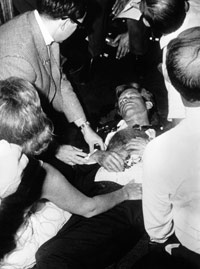
Bobby Kennedy asassination 1968

Martin Luther King assassination 1968

In 1968, three very important things happened in America. In April of that year Martin Luther King was assassinated in Memphis, Tenn.. In June of that year Bobby Kennedy was assassinated in Los Angeles, and in August of 1968 there were huge riots in Chicago at the Democratic National Convention, which assured that Richard M. Nixon would be elected the next President of The United States Of America.

The level of depression and anger that was being felt across this country, and the whole world for that matter, following these events, was palpable as 1968 moved towards it's final months. Because the shock of what had happened was so complete in that year, it was responsible for altering the lives of millions forever. It was hard to put your finger on exactly how much changed as a result of the year's volatility exactly, but I know that I had a feeling deep inside me that never left.

It was as if you finally knew that those in power were never going to let certain things happen. If you looked to change things too much, too fast, that power would rise up in one form or another and take you out. We had seen this happen, and then happen again, and again. It was as if it were being beaten into us through repetition.

Life changed! There was a sense of paranoia that was creeping into our lives in 68. The freewheeling open mindedness of the early 60's began to dissipate like a slow leak from a tire. It took some time, but the paranoia was definitely there to stay. Back in those days I began to reevaluate my own position in life.

One day Steve Clark approached me out of nowhere, saying he was having financial troubles, and couldn't continue paying me $100 a week to write songs for Since Music anymore. This was a devastating blow, but Steve also said he was trying to get Bob Ross, who owned Harmony Recording, to take on my publishing at Bob's own company, Teresa Music. Had I known at the time that Steve's reason for putting me with Bob Ross, was because Steve had used up the $10,000 Verve advance that he'd stolen from me, my whole life might have gone in an entirely different direction.

I liked Bob Ross alright, and knew he had a genuine interest in me, so I figured it would be OK for a while. In my mind I reasoned that by going with Bob, I could keep getting $100 a week to write songs. That money was all I had coming in, and I depended on it.

At the same time, Curt Boettcher was basically working himself out of Steve's grasp, and was slowly but surely making new plans for himself, Michele O Malley, Jim Bell, and the other Boettcher loyalists who had previously worked with Steve. I just stayed where I was, because Bob Ross was going to pay me, and I didn't want to be broke again.

There was talk of a new album by Bob, but there was no label offering to foot the bill at the time. I'd brought the Verve deal to Steve Clark, via Frank Zappa, for "Color Him In" the first time around, but now I was of no help as far as having a connection to an interested record company.

Possibly Steve's reputation, coupled with mine, was more than some people wanted to take a chance on at the time, who knows? But Bob Ross wasn't afraid. He kept the idea of an album alive, and had his own studio where we could cut the record, which would make it easier than having to go out and rent studio time somewhere else, which was expensive.

Between Steve and Bob cutting deals with each other, using my writing, publishing, and me as the artist for chips, they somehow managed to strike up a deal between them that they both could live with. Once again, I just stayed around because of the 100 bucks a week, it was that simple for me.


Demo from 1967-68 period

Wednesday, June 4, 2008

(part 76) NANCY HARWOOD


This is Nancy Harwood. She was a Playboy Centerfold in 1968, and my favorite of all the women I lived with. Note that I said: "lived with." I met her at Howard Gilliam's house in 1968, where I was living. She was beautiful, arrogant, and pushy, and I asked her to leave almost immediately. She refused. I asked her again and she said, "No!" I told her to get out, and again and she said, "No!"

She was used to getting her own way, and this became a test of wills, which she was determined to win. I stood up and walked over to where she was seated and said, "Goddamn it, get the fuck out of my house." "I don't want to," she said half smiling. I reached down and grabbed a handful of her hair and lifted her out of the chair.

She was like a cat being grabbed by the back of the neck. I drug her across the floor to the front door, opened it, and pulled her out onto the front porch and let her go, then turned and walked back inside slamming the door. In about 45 minutes the doorbell rang and I walked over and opened it, thinking it might be the police.

As I opened the door I saw Nancy standing there looking kind of sheepish and a lot less aggressive. She said, "I'm sorry I was so rude. Can I come back in?" I let her in and she didn't leave my side for the next year and a half. That's the way things happened in my life.

Nancy had been the girlfriend of Johnny Echols, from the band Love. I never knew how she ended up at Howard's house that day, but I never forgot it, and I'll never forget her. If there was ever a woman that I actually loved, it was her. She was a special creature, and I mean that in the very best of ways.

Nancy and I loved hard and fought hard, but no matter what happened she would not leave me. She was loyal to the bone where I was concerned, but I can not speak for Johnny Echol's experience with her, and assume it was his loss. Everywhere I went, people would stare at Nancy, then look at me, and wonder how I did it.

I used to get a kick out of watching guys try to get her attention and get her to leave me. It happened all the time and went on for as long as we were together. I got into a lot of fights because of it, but in a strange kind of a way I liked it, it meant I had something everybody else wanted and couldn't have.


Demo from 1967-68 period.