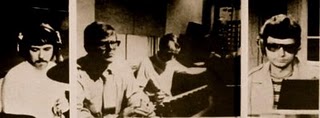
Friday, July 4, 2008

(part 86) NANCY, ME, AND THE ALBUM


Nancy Harwood

As I fought through the making of "Working," Nancy Harwood and I ended up subletting an apartment from Timmy Rooney, one of Mickey Rooney's sons. It was located across the street from the Shoreham Towers, where Diane Linkletter lived on the 6th floor.

I'd moved out of Howard Gilliam's house after he found out he couldn't make me do what he wanted. I had argued with him about performing solo at the Whiskey A Go Go, and he'd lost his patience with me over my final position. I told him that if he'd help me put a band together I'd do it. Howard's position was I didn't need a band, which had also been the position of Tony Alamo, and one that I'd rejected.

Anyway, that led to a break between Howard and me, so Nancy and I moved on. We ended up with a roommate in the new place, because he already lived in the apartment. His named was Ed Durston. I didn't want another roommate, but it was the only way Nancy and I could afford to live there.

The apartment was on the second floor of the building. Below us lived another musician named Jimmy George. Over the next few months I would get to know these people pretty well, plus a number of others, and they would all play a major role in another turning point in my life.

Ed Durston was a shady dude to say the least, but he was highly intelligent and quick witted, so if nothing else, he was fun to spar with mentally and verbally. I had to keep an eye on him though, because his interest in Nancy was obvious. Along with just about everybody else during those times, Ed was a loady, and to some extent that was more of a convenience than a problem. Ed always knew where to get drugs, so he did serve a purpose in the long run.

Both Timmy Rooney, and his brother Mickey Jr, were always dropping by the apartment to see how we were doing. They were well acquainted with Diane Linkletter, and within a short period of time, Nancy and I would get to know Diane as well.

As far as the album went, parts of "Working" had been heavily affected by the constant drugging and drinking that had become synonymous with the personality of Bobby Jameson. Some of the album's odder points are the vocals which were perfomed by me while drunk.

"Singin The Blues," "Ain't That Lovin You Baby," and "Norwegian Wood" are the most notable choices. There is no other way to say it except that I was "fucked up" when I recorded these songs. As well, "I'll Be Your Baby Tonight" and "Don't Think Twice It's Alright" were affected as well.

This may all seem repetitive and boring to some, but it is indicative of the physical and psychological slide I was on. There is, and was, a reason for everything, and what I am relating here is important, as fact, to the overall story as it truly unfolded at the time.

Each successive decline contributed to the next decline, etc. So the making of "Working," it's strengths and weaknesses, became a reflection of my life and visa versa. As the album went, so went I, and as I went, so went the album. They were never separate from each other. They were one thing.

This is why I ultimately crashed and burned as a human being. I had no ability to put each in it's own place. If one failed the other failed right along with it, and that was the case with "Working."

Both "Palo Alto" and "Bout Being Young" were solid performances, which is not to say you should like them or not, they were just handled with a lot more care than some of the others. If in fact the whole album was a piece of garbage, as some seem to think it was, and is, then I would have crashed even sooner than I ultimately did.

It was my hope that there was enough good about the album to override it's apparent weaknesses, and that is what kept me hanging on by a long thin thread. Nancy was always by my side during these times, reenforcing my value as an artist, and person, even when I was not capable of doing the same for myself.

She knew how important she was to me, and I knew how important I was to her. We were connected together by some invisible bond that was impenetrable by the world around us. Nancy saw the absolute best in me, no matter what anyone else said or thought, it was absolute.

There was no question for her about me, and likewise was my reliance on her. We walked through some very heavy shit together, and to this day I have nothing but the highest of praise to offer her. If the world had more people like Nancy Harwood it would just be a far better place for everyone, period.

She gave far more to me than she ever tried to get for herself, and I was extremely lucky to have known her and to have had her with me during those times. When the world came crashing down on top of me, and it always did and still does, Nancy was there to help scoop me up off the pavement, that's just the way it was then, and it never changed.

Thursday, July 3, 2008

(part 85) BROKEN WINDOWS Written and sung by Bobby Jameson "WORKING"


"Working" is the most obscure of the 3 Jameson albums. Because of that, far less attention has been paid to this work, and that continues to be the case. Other than my friend at "Echoes In The Wind," and a couple of other music blogs, almost no one has ever heard this recording until now.

There is no built in interest for this album, like there was for "Color Him In" and Chris Lucey's "Songs Of Protest And Anti Protest." As well, the other two recordings have been reissued as cd's while "Working" has not.

As I move into this particular segment of the Bobby Jameson story, possibly some of the interest has fallen off, proving there is more curiosity for certain specific parts, than there is interest in the whole story. Like a buffet, people stop in to sample what they have a taste for, and then leave with a doggy bag of scraps for later.

Unfortunately for me, I am stuck with the whole story. Not only the telling of it, but having to relive it once again. I struggle through my emotions and the past, trying to remember it all in some detail. But as I continue, I am aware that there is less interest in "Working," and what is contained musically between the grooves, as it were.

Because of this, I assume there may be some surprise at hearing a country song like "Broken Windows" on the record, which is one of 3 songs I wrote for this album. But I am confident as well, that if you take the time to listen to the music from "Working," you just might find what my friend Whiteray, from the blog "Echoes In The Wind" found: That "Working" is a highly personal creation by an artist, and is an album recorded in 1968 by the same person who made "Color Him In" in 1966, and "Songs Of Protest" in 1965.

This blog is the only complete and accurate source of information and music on the planet regarding the musical career and life of Bobby Jameson (aka) Chis Lucey that exists. It is not here to make you like me, or agree with me. It is here as an ongoing historical record of factual information regarding the specific subject matter of the history of Bobby Jameson. It is more like a human museum than a blog for passers by.

If you hear clicks and scratchy noises on all of the recordings from "WORKING" posted here, it's because they have been taken directly off 40 year old vinyl.

Once again I must thank Red Rhodes, James Burton, Jerry Scheff, Ben Benay, and Toxi French for their wonderful work...

Saturday, June 28, 2008

(part 84) SOMEONE WHO IS NO ONE

MY LIFE
HUNG LIKE A DISASTER
ON THE SPIKE OF TIME
THE SAME SPIKE
PIERCED MY HEART
MY HEAD
TOO MANY TEARS
TOO MANY DISAPPOINTMENTS
FOR TOO LONG
I WAIL
AT THE MOON
AND THE STARS
LIKE A WOLF
IN HIDING
I AM SOMEONE
WHO IS NO ONE
NO ONE
WHO IS SOMEONE
I DIE IN SOLITUDE
EVER DREAMING OF RELIEF
IT NEVER COMES
I TALK TO MYSELF
AND WANDER
THE LONG ROAD
MERCY MOCKS ME
LIKE A CRUEL HOAX
DECADE AFTER DECADE
I LOOK FORWARD
BY LOOKING BACKWARDS
INTO HELL
I AM ALONE
I AM NO ONE
WHO IS SOMEONE
SOMEONE
WHO IS NO ONE

Bobby Jameson June 28, 2008

Friday, June 27, 2008

(part 83) ACT OF CAPITULATION


Making the album "Working" was somewhat of an act of capitulation for me, following the trouble I'd had with Verve over writing songs that many deemed questionable. At the same time, I was extremely focused on trying to create a work of some merit.

I chose, and was forced in part by circumstances, to write less objectionable material for the album. By limiting the number of my songs, and using other people's material, I found a way to make the album and sidestep the fight over what I could write for it. It was a new process for me. The only other time I'd done it was in England, when I recorded "All I Want Is My Baby/Each And Every Day" in 1964.

I wanted to record an album, so I created a way to do it, by agreeing to a different direction with "Working." Had I been given the freedom to record what I wanted, following "Color Him In" and prior to "Working," there would be an entirely different record than the one I've been discussing here.

So when I say it was somewhat of an act of capitulation, I mean it. There weren't a lot of opportunities available for me at the time, so I had to choose between standing my ground, or compromising on the type of music I recorded. Making demos was one thing, recording an album that would get released by a label, was another.

In the back of my mind, all the way through the "Working" sessions, was a building resentment over the lack of freedom I had in choosing the kind of album I wanted to make. Although I gave it my all, I knew in my heart that there was another record that should have been being made.

In 1968, following the difficulties of having been on trial for a year, I was aware that a position of strength was not where I was standing. It was to some degree, "take it or leave it" territory, and I tried to make the best of it. Bob Ross, a rather conservative man, was footing the bill, so he was the one dictating on the subject of content.

I do not begrudge him his position at the time. It was his sincere belief that I was capable of writing the right kind of material, and making a good record that both he and I would be proud of. Because of his sincerity, I was able to invest myself in the project as much as I did.

The various difficulties in the way I ended up recording the album were taken in stride by everyone who worked on it, as a necessary decision to insure that the tempos and meter were true to the way I interpreted the songs.

The live performance quality of the album was the one thing I refused to budge on. This of course could have been overcome, if I and the musicians had had endless time to get it right, which we did not. I knew that if I recorded it in the traditional way, the album was not going to portray, in the slightest way, how I played and sang these particular songs.

It is in fact, the essence of what made "Working" different, as well as valid, which over time it has proven to be. The Band, whose song "The Weight" I recorded on the album, has given "Working" a page of it's own on their website out of respect for my version of their work. There is a link "Bobby Jameson Working" at the top of the blog page where you can click to that site.

(part 82) MY LAST DITCH EFFORT


click

Trying to make "Working" work was my last ditch effort as a recording artist in 1968. Parts of the album are in a way desperate. When I listen to it, I remember how hard I was trying to make things work. Some of my vocals are exactly what I wanted, and some are attempts at it.

As the alcohol and drugs continued to play a bigger and badder roll in my life during the recording of this album, I would reach higher and fall lower than I had at any time previously. On some days I was completely OK, on others, I was prone to violent outbursts, depending on what I had in my system, and how much of it I'd had.

By 1968, the previous years of using now began taking a serious toll on my ability to guage how loaded I was, or how loaded I was getting. Trying to record in that self imposed prison was at best hit and miss. I was not only addicted to the drugs and alcohol, but to fame as well.

I lived at times, in a world constructed of unreasonable demands and bitter resentment, regarding my past dreams and failures, and my then current fears about the future. My need for attention, and demands for it, continued wreaking havoc with my personality throughout the making of "Working."

Unfortunately, I again put all my eggs in one basket. I hoped against hope that this time would be the time, and that this record would be the record, but neither of those things were true. I always seemed to do the same thing. Over and over, just as I'd done before, expecting a better result than the ones in the past. It seemed to be the only way I could do things.

I lived in a rut. I never learned to deal with things. I just learned how to make records and write songs, and then do it again and again. My skills at being a person were limited to that in many ways, being a recording artist and a song writer, in search of myself, fame, and fortune.

To be honest, I didn't understand enough about the world I lived in. There it was, and here I was, and my job was to get the world to accept me, rather than me finding a constructive way to fit into the world. In essence I was always at war with everything and everybody around me, unless it went my way.

The drugs and alcohol just tended to magnify it all, and that's why "Working" is so important to me, then and now. It was my last cohesive attempt at getting the world to accept Bobby Jameson, which it never did.

I will attempt to make clear the ins and outs of constructing "Working," and the time I spent with some extremely generous and talented musicians, who helped me create the last album I released.

The record is shot through with my then growing interest in suicide as an answer to my life, should I have to face yet another failure. This is the source of the desperation, power, and tiredness in these vocals.

"Ain't That Lovin You Baby"

Wednesday, June 25, 2008

(part 81) "WORKING" THE 1968 SESSIONS


The musicians on the "Working" sessions in 1968 were Mike Deasy fuzz guitar, Jerry Scheff bass, Toxi French drums, Ben Benay guitar, harmoica, and arranger, James Burton dobro guitar, Red Rhodes steel guitar.

Strings and horns, Sid Sharp, Bill Kurdsch, Leonard Malarsky, Harold Dickrow, Tibor Zelig, Jesse Ehrlich, Armond Kaproff, Israel Baker, Nathan Gershman, Bobby Bruce, Ray Kelley, Jerry Grant, James Horn, Roy Catron, Olie Mitchell and Dick Hyde.

The arrangers were Sid Feller, Ben Benay, and Mike Hendersen. Produced by Steve Clark, engineered by Fred Borkgren, and recorded at Bob Ross's Harmony Recording Studio in Hollywood. Piano and vocals by Bobby Jameson.

Jimmy Rees's "Ain't That Lovin You Baby" and Bob Dylan's "Don't Think Twice It's Alright" were arranged by Mike Hendersen who played sax on "Jenny" from "Color Him In." The "New Orleans" string and horn arrangements for those two songs are similar to the arrangements of Bob Dylan's "Everybody Must Get Stoned".

The vocal I did on "Ain't That Lovin You Baby" is a flat out half drunken rendition of the song, that if nothing else gets your attention. "Don't Think Twice It's Alright" is a bit more relaxed, but again is colored with the fact that I was pretty well wrecked when I recorded both of these songs.

The vocals give a lot, and are lacking a lot simultaneously. They are live recordings and not overdubbed, so they don't have the control factor of rerecording each vocal till it's perfect. The quality is more like a stage performance than a studio recording.

Some people hate this album for that reason. The vocals on "Palo Alto," "Bout Being Young," and "Broken Windows" are far more controlled, and have more of a studio quality about them. "Palo Alto" was a song I wrote about my mother, and the fact that I didn't believe we knew each other too well, and I wondered if we ever would.

I placed the lyrics in a "what if" situation regarding life and death, and questioned whether anything would ever change. "Palo Alto" was arranged by Sid Feller who also did the arrangements for "Gentle On My Mind" and "Bout Being Young."

"To Ramona" was the fourth song arranged by Sid Feller, and I have already stated it did not make the album. That was a choice by GRT Records executive Ron Cramer, who decided the album was too long. GRT stands for General Recorded Tape. It is the label that released "Working" in 1969.

Sid Feller had done arranging for Ray Charles in the past, but I was not satisfied with his work. I felt that he over arranged the songs, and think they'd have been better, if they were leaner in the overly lavish string and horn arrangements. Once again I was not in enough control of the album to have a say about this at the time of the recording.

I am of the belief that my vocal on "Gentle On My Mind" is one of my best efforts, and wish the arrangement was more like a Jimmy Webb arrangement. Sometimes, less is more, when it is used surgically. Sid's arrangements were overbearing at times, and fought with what I was doing vocally.

On the other hand, everything but my voice and piano was overdubbed, so I guess it was hard for them to write their arrangements after the fact, as opposed to before, which I know they were used to doing. It was the only way I could get the songs recorded the way I wanted though, so on one hand it works, on the other it doesn't. The one thing I can say about "Working" is, that I could sit down at the piano and play the whole damn album the same way it was recorded, and that was not the case with "Color Him In."

"Gentle On My Mind"